THE STATE VISIT- A Review by Wole Oguntokun
The State Visit by Niyi Osundare is a Stage Drama published by Kraft Books Ltd in 2002 but first performed by The Creativity Workshop at the Arts Theatre of the University of Ibadan in 1997. The genre chosen for expression by the writer is a sartorial comedy.
The location is the fictional Yanke, which appears to be a thin veil for Nigeria itself and the antagonists are the ruler of the country simply known as “Head” and his entire cabinet of ministers. The Head and his ministers prepare for a state visit by a ruler of a neighbouring country, Wilama, hence the title of the drama, a visitor known by many names including the “Son of the Leopard, Descendant of the Towering Giraffe, Offshoot of a warrior family…” amongst many others.
Many Nigerian playwrights consider it a point of social responsibility to discuss the issue of the excesses of their military leaders and Professor Osundare is no exception. Wole Soyinka’s King Baabu, this writer's Who's Afraid of Wole Soyinka? and Deji Toye’s Botching of a Brute are examples of work done in this regard.
The cabinet of Yanke, an obsequious crew that follows its leader, the Hyena of Yanke to the point of absurdity in his various schemes are given curious characters by the playwright bordering on the farcical. The Minister in charge of Public Morality is female but spends time engaging in touching and being touched in sensitive areas of her body by the Minister of Agriculture, all these taking place during cabinet meetings. It appears the Minister of Agriculture whose ministry is deprived of money designed to keep the masses from starvation is a form of the former Roman Emperor Nero who fiddled as Rome burnt. This minister has no problem with the impending starvation but finds the threat of hunger to the people amusing.
The Minister simply known as “Agric” says: “What future are you talking about?” The future is not the problem now. When it comes, it will take care of itself. Let us eat and be merry today. Why should we bother about tomorrow? You can only grab what you see.”
The Minister of External Affairs is lent more intelligence than the entirety of the cabinet combined, indicating to the reader that sometimes, the dictator-rulers of Africa often add members of the intelligentsia and academia to their ranks, people who should know better but instead become willing aides in the continuous pillaging of the African continent.
The voice of conscience in the cabinet of Yanke’s government is the Minister of finance who makes his opposition known to his fellow cabinet members and the Head of Yanke. He then walks out on the cabinet and is replaced by a more unscrupulous and opportunistic Finance minister. It is unlikely that in reality, any finance minister could state his opposition plainly to a ruler like the Head. Opposition is not accepted lightly by people of this ilk, is regarded as a personal affront and extreme and final steps are taken against thos regarded as disloyal. Sanni Abacha of Nigeria (who appears to be the Head) and Idi Amin Dada of Uganda are examples of the reactions of maniacs in power.
There is an official journalist for the Head and his ministers and the extremes gone to, so as to be perfect in the pictures taken are absurd, ridiculing the entire cabinet. It appears that the main pattern of satirizing the excesses of African and particularly Nigerian leaders is farce. The journalist represents those that fiercely opposed the Head but who were bought over by subtle threats and the largesse given by the government to those it tries to silence. The question to be asked here is, “Does everyone have a prize?”
Even today, in modern day Nigeria, it is obvious that parallels may be drawn between the cabinet of Yanke, deaf to the entreaties and sufferings of its people and the ruling government in Modern day Nigeria peppered with members of the ruling political parties.
The discontented people of Yanke are represented by a selection of beggars, students, workers and a discontented painter who refuses to use his skills for preparing for the visit of the neighbouring ruler. The beggars tell their own stories of how they have been betrayed by the state, left to fend for themselves in extreme deprivation. It is obvious that Yanke is a failed state, lacking all forms of welfare for its people and the similarity to the Nigerian situation is extremely disturbing to this reader.
One of the beggars becomes a alms-receiver as a result of an accident with a piano he was helping to unload. The Piano itself, an instrument of cultural enlightenment meant for his master‘s daughter, falls on him as he helps with the unloading, and causes him the use of his limbs. The master, representing the upper class does not see to his welfare and subsequently he becomes a beggar. The symbolism of the piano as an instrument of subjection and repression is a striking one.
The painter (or creative person) who refuses to work for the Lion of Yanke fearlessly calls the entire cabinet derogatory names to their faces. He refers to them as tyrants and vampires but the Head chooses to remain obtuse, not understanding what is being said. When the cabinet finally realizes the “artistic” insults of the painter, the ensuing rage costs the painter his life.
The State Visit does not take place, at least in the play as the people violently resist the excesses of the Lion of Yanke. The Narrator is left to finish the story in the end, saying that “Yanke will never be the same again” and indeed the songs of opposition are heard continuing despite the deaths of several citizens at the hands of the law enforcement agents of Yanke. The Narrator who set us on the path to an understanding of the play ends the performance and it appears as if the future of Yanke is in the hands of the people and whether they will choose to react or be silent. One wonders if this is a call to revolution by the playwright. For those who might think all revolutions are calls to anarchy, we must remember that we have seen the success of a rose revolution where no shots were fired but where the people took back the reins of government from undeserving leaders.
The writer seems to be comfortable with a didactic approach, one where lessons are taught and learned and indeed the entire play through its Narrator, plot, twists and the development of its characters teaches moral development all the way. The helplessness and frustration of the citizens in the country today are well thought out and a way out is revealed by the playwright. The people must speak up and reclaim what is theirs or die in the throes of tyranny.
Thursday, March 15, 2007


Professor Niyi Osundare
LOVE POEMS AS PRINCELY CATHARSIS
A review of Niyi Osundare’s TENDER MOMENTS
by Folu Agoi
INTRODUCTION
There is a popular notion that violent games sometimes exert a positive effect. This is often achieved by means of catharsis, which refers to the process of discharging, and thereby providing relief from, powerful or repressed emotions. The seat of all emotions, especially love, and thoughts is the heart. Love is the basis of all existence. Love rules the world. This seems the basis for the publication of TENDER MOMENTS, a collection of love poems authored by Niyi Osundare, the Ikere-Ikiti- born Professor of English (now at University of New Orleans, USA). The collection, published in 2006 by University Press PLC, Ibadan, reflects a marked departure from the previous collections for which the African leading poet is generally acclaimed as a political poet renowned for his rather combative style. These publications, based mostly on the socio-political circumstances of his beloved country, Nigeria, include: Songs of the Marketplace (1983), Village Voices (1984), The Eye of the Earth [joint winner of the 1986 Commonwealth Prize for Poetry] (1986), Moonsongs (1988), Midlife (1993), Waiting Laughters [winner of the NOMA Award] (1990), and Selected Poems (1992).
CONTENT
As hinted above, the heartland of every worthy, sterling endeavour is passion. Passion is the blood that runs through the veins of the writings that portray Osundare as a literary firebrand, die-hard political poet, and indeed, his latest offering, which is based on the supple subject of love. Though each of his previous publications, especially the award-winning work, The Eye of the Earth, is jazzed up with spicy lines, TENDER MOMENTS, which accentuates the Poet Laureate’s humanity and shows him as a man of intense, fierce passion, is his first exclusive work dedicated to the celebration of love. However, some of the poems betray strong political undertones, e.g.:
So even now that the GeneralDecrees death from the distance
Of rocky castlesNow that legislated Terror reddens the streets
All the powerful lies usurpThe lanes of complacent ears (“You Gave Me Memory”, p.26);……………………………………I wanted so much to comebut there were corpses across the path
The generals, drunk on beer and blood,emptied mortar shells into surging crowds,in desperate awe of a foe called democracy (“Love in a Season of Terror”, p.33);
The 102-page publication, which parades 77 verses, classified under three main headings (In the Mood, Songs of Absence and Metaphor), opens with a poem entitled “In the Mood for Love”. This 12-stanza poem, spiced with the following refrain, effectively sets the stage for the thrilling odyssey of romantic poetry, bearing much evidence of surrealism, which awaits the reader in the collection:
Sun mo bi, Ologuro (Move closer, Sweetheart)I am in the mood for love tonight.
The poem is crafted against the backdrop of the moon, as if stressing some link with Moonsongs, an earlier collection of the nature poet:
The moon is playing hide-and-seekBehind the clouds. A mellow smileLingers on the lips of the sky (p.3).
This poem is followed by “You Are the Reason” and “Love Can”, a 3-part poem introduced by the following paradoxical lines, which seem a precursor of the strong feelings about the character and power of the subject of the volume, love, articulated in the verse with copious employment of oxymoron (bitter sweet, heavy light), and (also in other poems in the collection) antithesis, metaphor, simile, personification, etc.:
Love hurtsLove heals
……………………………Your buttocks like loavesRising in the furnace of the sun. (“You”, p.85)……………………………
Your breasts are two virgin hillsWith their pinnacle of paradise. (“Metaphor”, p.96)
……………………………….
“Tender Tormentress”, p. 23, is another poem in the publication that reflects the use of oxymoron. However, the 3rd stanza of the poem bears what seems an isolated case of typographical error:
in the feathery sockets of of a voice...
Other poems in this section include: “The Evening of Your Smile”, “Forbidden Song”, “Firelove”, “04 04 04” “Special Day”, “Touch Me”, “You Are”, “Not Now, Desdemona”, “Adumaradan” (Yoruba and English versions), “Queen of the Night”, “Divine Command”, “Tender Tormentress”, “Tender Moment”, “Tasks”, “You Gave Me Memory”, “Born in Every Land”, “Breaking Bread”, “Beehive”, “the Fish in Your Eye”, “Phone It in”, “Puzzle”, “Love in a Season of Terror”, “Public Passions”, “Laughter without Forgetting”, “Who’s Afraid of the Mermaid?”, and “The Longest Love Poem in the World”, which contains only one word:
Yes...
The 2nd segment (Songs of Absence) comprises: “Song of Absence” (1 & 2), “These Many Moons”, “While You Were Away”, “Borrowed Paper”, “Chase”, “Three Sadnesses & an Acre of Laughter”, “Promise”, “Where?”, “Miles and Rice”, “Bulb Eyes”, “Airport”, “Love from the Sky”, “Fly Fast”, “Fly Me”, “I See You”, “Have You Seen Her?”, “Heart’s Eye View”, “Skirt”, “Rain or Shine”, “Dusk”, “Endnote”, “Under Another Sky”, “Tidings/Trade Winds”, “Closer by Far” and “Elephant Across the Path”.
The verses in the 3rd section, captioned Metaphor, are: “Questions for a Poet’s Wife”, “Bless”, “Keep the Window Open”, “Love Grows in Your Garden”, “Apple of my I”, “Mood”, “You Taught Me”, “Liquid Legend”, “Mountains”, “You”, “No-Yes”, “Loreving”, “My Miss Take”, “Do It”, “Grafted”, “Melody”, “Ebony (1)”, “Born Between Two Seas”, “First Love”, “Dogon” and “Metaphor”.
STYLE/LANGUAGE
The verses in TENDER MOMENTS are, in the main, lyrical. These poems exhibit the essential ingredients of African poetry, which is largely panegyrical, dramatic, and musical. Most of the poems in the collection, especially “Bless” (p.75) could be sung to the accompaniment of drums, gongs, flutes, horns, sekere (rattle gourd) and other African traditional musical instruments.
Some of the poems feature refrains and songs; e.g. “In the Mood for Love” (3), “Adunmaradan” (pp. 17 & 19), “Elephant Across the Path” (p.68).
Though blank verse is employed in much of the poetic content of the publication, the poet reflects much industry and discipline, especially in the area of versification. The verses in the collection are mostly consciously skilfully patterned; e.g.:
Hold me tightUnfreeze my night
Count my teethWith the tip of your tongue
Deck my neck with a golden wreathKnock me our with your endless song
Climb my mountain and pluck a starLove’s blue sky is never far. (“Do It”, p. 89)
Virtually all the poems in the collection are imagistic. Vivid imagery, mostly drawn from the poet’s home environment, is employed. The dominating images in the publication are those that appeal to the senses of sight, touch and smell.
Wherever you goSomething follows:A pair of happy mountainsDifficult not to seeImpossible not to love. (“Mountains”, p.84)
……………………………….Did you feel a tingle between your legsAs you passed through our haunted spots (“These Many Moons”, p.43)
One unique feature of TENDER MOMENTS is the interpolation of Yoruba expressions in many of the verses that make up the collection. For instance, the opening verse, “In the Mood for Love”, is spiced up with a curious refrain composed of an exciting intermixture of Yoruba and English lines:
Sun mo bi, Ologuro (Move closer, Sweetheart)I am in the mood for love tonight.
The author’s recourse to the rich linguistic repertoire of his homeland is not peculiar to this precursory poem, as could be seen in the following samples:
“Adumaradan”, a poem written in Yoruba, and translated into English (pp. 17 -19);
“Alabaun abandons its tabernacle of tricks” (“You Are the Reason”, p.5);
“A universe of iyan, a fragment of fishSwimming lustily in a sea of sokoyokoto” (“Phone It In”, p.31);
Patonmo (“Endnote”, p.64);
Awero (“Tidings/Trade Winds”, p.66);
Another prominent element in the collection is humour. This is reflected in the content and diction of virtually every poem in the work, especially the poem entitled “Mataphor”, p.98, which is based on El Postino, a love story woven around Pablo Neruda. The poem, which features a colourful cinematic plot, also highlights Osundare’s excellent quality as a fantastic wordsmith:
Meta meta metaphor meta lo fo kii se kan.
This expression is a trans-lingual, Yoruba-English pun: metaphor bears multiple meanings; in Yoruba, meta lo fo means three is what it means.
The language employed in the volume is largely limpid and racy, if not risqué or earthy. This is reflected in virtually all the verses in the collection, replete with concepts and images that would have been adjudged vulgar were it not for the poet’s masterly, creative use of language. Here are a few samples:
Love can swim like a fire-tailed spermthrough the dark caves of desirewhisper wet wonders in the ears of eternal circles. (“Love Can”, p.6) ………………………………
There is a secret flowerbetween your legs behinda thicket of thornsand a thousand touch-me-nots. (“Forbidden Song”, p.10)………………………………I soar lovewardsIn the firmament of your breast. (“Firelove”, p.11)…………………………And so you said:‘Let us go behind the wallsAnd I will show youThe birthmark below my navel’ (“Tender Moment”, p. 24)…………………………….My song will find you in your flair of feathersEven as I touch you in your soft, abiding core. (“Tasks”, p. 25)
CONCLUSION
The verses in TENDER MOMENTS, the author’s first major publication after he lost his entire library and other valued possessions to Hurricane Katrina, which ravaged his New Orleans (USA) home in 2005, is obviously an authentication of the humanity, and perhaps, the fecundity or virility of the 60 year-old author. The robust, strong, somewhat daring collection, which is an attestation to the affirmation of life, indeed lends credence to the notion of the indestructibility and immortality of the creative spirit.
WORKSHOP ON BOOK EDITING...
PRESS RELEASE
CORA HOSTS A WORKSHOP ON BOOK EDITING
The Committee For Relevant Art (CORA) is working, in partnership with Bookbuilders Limited in Ibadan, on a workshop for Book Editors. The event will run from April 26 to 28, 2007, at the Goethe Institut in Lagos.
The workshop is the first attempt by CORA to engage in capacity building for the Book industry.
The idea of the workshop is to develop a generation of fully trained book editors who are envisaged to energize the book industry with the editorial skills that are so lacking in current literary and scholarly books.
In hardly any of the few operating publishing houses is there a book editor of redoubtable skill and renown. “Indeed, so negligible is the impact of editors on the few books that are published that nobody makes the ordinary connection between editing and the quality of a published book”, according to the CORA proposal.
Mrs Chris Bankole, the key facilitator, and Mrs Sherifat Oladokun, both of Book Builders Limited, a highly regarded firm of book editors, will give closed-session lectures, seminars, and tutorial-style meetings. Participants will have the opportunity to engage in practical demonstration of how a book is worked on. They will learn about the role of the editor in relation to the publisher, agent, and author, and the differences between a newspaper editor and a book editor. There will be illuminating conversations on a range of topics including Initial assessment of a book, Copy Editing, Substantive editing, Proofreading, Indexing, Cover design, Grammar and useage, cliches, Nigerian malapropisms. It will also look at challenges in editing creative writers; both of children and adult fiction, as well as Scholarly/ tertiary publishing / research vs university, textbooks. Participants, who will pay 10,000 naira for three days (which covers tuition, course materials, tea/snacks, lunch, certificate and group photograph) will be taught Footnote / reference styles, publications of Newsletters / flyers / brochures as well as how to handle tables / diagrams / maps etc.
“The experience is not substitute for a sustained academic program in publishing”, the proposal reads. But we hope that participants will gain a lot from this workshop to develop career interest in book publishing. The organizers look forward to hearing from such large (mostly erstwhile multinational ) publishers such as McMillan, Longmans, Evans, as well as homegrown, midsized companies including Spectrum, Africana, 4th Dimension, Litramed. The workshop will be particularly useful for emerging companies like Farafina, New Gong, Cassava Republic, BookKraft, Kraft Book .
Perhaps the major beneficiary from this sort of learning would be people between ages 22-40, preferably university graduates or those in the final semester of their bachelor programs, with demonstrable interest in reading and writing.
Graduates that can produce their certificates may not necessarily present their transcripts. Staffers of reputable publishing firms should only need to present a letter from their employer authenticating their status. Completed application package will include a letter of application, and a statement of purpose. For those who are not working in a publishing house, there is, required, a letter of recommendation from academic mentors or teachers.
Contacts: CORA Secretariat http://www2.blogger.com/ym/Compose?To=cora2stamp@yahoo.co.uk, Ayo Arigbabu, (http://www2.blogger.com/ym/Compose?To=arigbs@gmail.com), Jumoke Verissimo, (http://www2.blogger.com/ym/Compose?To=jumokeverissimo@yahoo.com) Juwon Bukola Phillips(naijajuwon@yahoo.ca) and Wale Omotoye (geewale@yahoo.com)
Thank you so much,
Toyin Akinosho
Secretary General
Saturday, February 10, 2007
More on 'Prince Claus'


 Top Picture- (from left) Film Producer and actor, Francis Onwoche, with Journalist and Media Officer MTN (telecomms)Nigeria, Yinka Ijabiyi, along with Layiwola Adeniji, former Arts Editor- This Day (who anchored the event) and poet and Advertising Practitioner, Chike Ofili.
Middle picture-The Ambassador with Makin Soyinka
Bottom picture- from left, Makin Soyinka (film producer and son of Nobel Laureate, Wole Soyinka), Kayode Akintemi (RadioProducer/presenter), Chief Joop Berkhout(Chairman/ Publisher of Spectrum Books) and Ambassador Van der Wiel
Prince Claus...


In the first picture, the Netherlands Ambassador to Nigeria, gives his speech at the ceremony for the 25, 000 Euros 'Prince Claus' Award to CORA. In the second picture, Toyin Akinosho, CORA Secretary General, receives the Award and Cheque from the Ambassador.
Ozzidi
 The Ozzidi King, Sonny Okosuns, will be honoured by CORA as he turns 65 at its 65th Great Highlife Party.
Venue is the O'jez restaurant at the National Stadium, Surulere, on Sunday February 25 at 6pm.
Saturday, January 27, 2007
64th Great Highlife Party...

CORA celebrates Femi Asekun, Veteran Journalist as he turns 75 at the Elders' Forum.
Date is the 28th of January from 5.30pm. Venue is O'jex Restaurant, National Stadium, Surulere, Lagos.
The young and the Elders are invited.
Thursday, January 11, 2007

Saturday, January 06, 2007
Prince Claus again...
 Seyi Solagbade, the palongo exponent of the music band, "Black Face", anchors himself just before the 25,000 Euro Prince Claus Fund award for CORA in December which held in the embassy of the Netherlands. In the picture below, Jahman Oladejo Anikulapo (Chair person of CORA programmes and Editor of the Guardian Newspaper on Sunday), (left) practices the fine art of Kung Fu with a Ninja at the embassy. Actually, the gentleman in the black cloak was one of those who came to CORA's assistance as preparations were made.

Literature and The Niger Delta Region...
CORA organized an Arts Stampede where it brought three writers who had  written on the Niger Delta region and its complications. In the picture, left, is Kaine Agary, author of the work of prose, Yellow Yellow, along with the compere of the meeting, Makin Soyinka. The quartet in the picture are members of the African folk song group, Nefretiti, which performed at the Stampede too. Along with Kaine were Professor Tanure Ojaide (author of The Activist) and Dr Ahmed Yerima (The Hard Ground)

written on the Niger Delta region and its complications. In the picture, left, is Kaine Agary, author of the work of prose, Yellow Yellow, along with the compere of the meeting, Makin Soyinka. The quartet in the picture are members of the African folk song group, Nefretiti, which performed at the Stampede too. Along with Kaine were Professor Tanure Ojaide (author of The Activist) and Dr Ahmed Yerima (The Hard Ground)
Literature and the Niger Delta
 Makin Soyinka
 with Tanure Ojaide (in black and yellow top), writer of "The Activist" and Ahmed Yerima, author of "The Hard Ground".
Monday, January 01, 2007
The Great Highlife Party

 It was the Great Highlife party organized by CORA at the O'Jez Night Club in honour of the octogenerian and music maestro, Steve Rhodes on New Year's Eve. In the picture, right, is the General Secretary of CORA, Toyin Akinosho, who eats 'the last supper' of 2006. The picture with the three 'giants' seated has from left, Steve Rhodes, the veteran broadcaster, Femi Asekun and Francesca Emmanuel. Bottom picture in the baseball cap is the Highlife veteran, Tunde Osofisan and pictured with the trumpet is Maliki Showman, another legend from the glory days of highlife.


Wednesday, December 27, 2006
The death of Agbroko...by Jahman Anikulapo
Godwin Agbroko, the former Editor of African Guardian, The Week, Newswatch, and lately Chairman ThisDay Editorial Board, was brutally killed on Friday(December 22) night, less than two kilometres to The Guardian's Rutam House office.
Ruonah, his (awaiting NYSC) daughter published the article below the following day on Saturday, December 23. Now, I know why i have been so sad ever since Oga Goddee -- as we fondly called him at The Guardian in his days here -- was murdered. In some ways I have become an extended member of the family…
I had not met any other member besides Oga Goddee, until I met Ruonah, the daughter by accident on Wednesday December13… well, I had met her through reading her columns on the pages of ThisDay Plus every Saturday… I recall that I had even had occasion to make enquiry about her, having read one of the stuff she did on, I think, the fuss about dressing culture of the young… I need to check this out.
I thought that for a young person herself that depth of reasoning san all those stuff about `they are young, let them explode' was inspiring…I was talking about meeting Ruonah physically, right?
Now, on December 13, I had gone to Eko FM as a guest of the popular `Breakfast With Mr K', a programme thatis truly innovative in every sense of the word.... it is broadcast live from the studio of Eko FM but it is cast also on the internet such that anywhere you are in the world, you could access it. In fact while I was in the studio (with NAFDAC's heroine, Dora Akunyili)calls came in from as far as France, UK and the USA. Also, inventive is the Celebrity News Reading .. I read the news with Dora…. come deh shake gbirigbiri for mouth… even though I had done same (and on magazines) in 1986/1987 with FRCN as a jobless fresh graduate, and later in mid-90s as an adventurous co-presenter on The Beat (with Kole Ade-Odutola andToyin Akinosho)…
Anyway back to meeting Ruonah: I was embarrasingly late into the studio that day. I was expected at 8.20pm, but did not get in until about 9.10 am. Why? It was the day the madness of Governor OjuYobo Tinubu's Lagos (may God deliver us from his spell ofi ncompetence and inept governance in 2007) decided to play its worst drama. The traffic was maddening, as Area Boys and all the crazy fellows in uniform mounted inexplicable barrierseverywhere.. .
Surprisingly the traffic only occurred where-ever you see Tinubu's uniformed rogues!.... at other places, trust Lagosians, they got around to sorting (or slugging) it out. Well, sadly and out of character, I made the studio solate.
As I rushed in there, I was accosted by a slim lady in a smart jeans dress... `Uncle Jahman, so this is you...' she washed off my mix of agitation and anger. 'Uncle Jahman? I had to look around for that fellow… `Uncle!'Me ke? Me that should have been flogged for getting late to alive programme. Well, I unleashed the tyranny of my tongue... I am so sorry, it is this impossible Lagos, those crazy Danfo drivers, the madmen of Lagos trafficscheme bla bla......
`No, Uncle don't worry we wereall victims of that traffic too. Ruonah said. " I spent two hours on that same route.. from Ire Akari", she had recounted. "It wasserious o, Uncle..".`Uncle', again! Okay, it is me she is talking to, right? But who is this smiling lady Uncling me all the way? I was still working out the best way to get that query across, when she helped out…My Daddy speaks so highly about you? I even told him Iwanted to start writing for Life magazine. I love whatyou do with that magazine. My dad loves it so much,and so I told him I would want to write for themagazine. Her Daddy?
`He said he worked with you at The Guardian?' All the while I still had no clue.. Ruonah who?Haaaaa!`Writing for Life is simple…. Okay, give me your number..'She wrote her name,,, and wala! Ruonah Agbroko!
Oh, so you are my Uncle's daughter? She smiled. You are the columnist in This day, the one I have been reading… wow, you are so young…. She broke out in a broader smile now…. And a wink of caution had to come from the studio minder… as Dora was all the while being interviewed by the main anchor/ initiator of the programme – Kayode Akintemi. As I was going to keep the praise-singing going on, Iwas summoned to join Dora at the Mic to present the news…. That broke my fascination with this young, deep and intense lady.. one I could actually call my niece.
In any case, we continued after the programme, as she reminded me of her earlier request to be part of the committee for Relevant Art's subsequent programmes. That was when I invited her and the entire crew of the`Breakfast with Mr K', to the Formal Presentation of the Prince Claus Award to CORA holding the next day December 14 at the Netherlands Embassy on Lagos Island. The team attended the show. I recall Ruonah dressed in skirt suit, looking fit and trim. I think I joked that she looked like an air hostess, and earned that smile once more. The team was busy on that day – it was desirous of talking to Ambassador Ariel Van der Weil, who was chief host of the day, which explained why we eventually never got to talk.. but I saw when the four-some `Breakfast with Mr K' team was leaving thevenue. A joyous group, I remember now. I saw that smile again.
Now I shudder to see tears roll down those innocent young cheeks that spoke so passionately about `My Daddy…'; My Dad'.. on my first encounter with Ruonah. For that, I have been hell scared to head to the family house in the Isolo area to pay my respect to Oga Goddee, that committed journalist, fine columnist whose main writing virtues were the depth of his thought, sincerity of intellection, and simple-ness of prose… the man who as Editor of the African Guardian, accosted me one day on the staircase, gave me a stick of cigarette and bellowed... `No think say na only Guardian and Lagos Life you go deh give all that your arts stories… we deh here too o'… He did not even wait for an answer from my shocked lips, he just walked on in his`rolling style'…
But that was what launched me into copies to that magazine that died an untimely death with the Abacha proscription in 1996.
HERE IS RUONAH'S ARTICLE PUBLISHED SATURDAY DECEMBER23
The Prince Claus/ Cora ExampleBy Ruonah Agbroko, Email:wudupls@yahoo. com, 12.23.2006
A week ago, I heard for the first time that His RoyalHighness, Prince Claus of the Netherlands in 1996 hada fund inaugurated in his name as a 70th birthdaypresent. What this has got to do with the price of teain Milan? Well, nothing, really. But, it’s got a lotto do with Nigeria. And the issue is that the PrinceClaus Fund for Culture and Development made Nigerianculture advocacy group, CORA, a recipient of thePrince Claus Fund Award 2006 worth 25,000 Euros,(approximately N4 million).
Principal Officers of The Committee for Relevant Art(CORA) went on air to aptly say the awards were “mannafrom abroad”. That innocent people like you are hearing CORA, or Prince Claus for the first time doesnot at all faze me. What does is the fact that thename CORA had been heard and read in the proposallists of almost every corporate organisation in Lagos,and yet, “for 15 years CORA was run without governmentor foreign donor support”. Granted, a prophet is without honour in his home, butwhat kind of a home celebrates the ‘prostitute’children and frustrates the ‘well-behaved’ ones?
Everything, from crappy comedy shows to the albumlaunches of washed-up artistes bear long, long listsof blue-chip sponsors, yet, an organisation that has convened amongst other things- seven editions of TheLagos Book and Art Festival and fifty-nine ‘ArtStampedes’ (a discursive platform) still manages to gounheard of and un-helped by the overwhelming majorityof Corporate Nigeria. Speaking to the members of CORA whom I have known for some time, they put flesh on the skeletons of my thoughts. Most corporate individuals and organisations are always on the lookout for cheap and loud avenues to exhibit corporate responsibility. That is normal. What, however gets my goat mewing and my cat bleating is the irresponsibility with which these avenues are chosen.
Credible, enduring avenues are irresponsibly veered-off while faddish unnecessary routes are taken. Let me explain. Oftentimes, the bearing, or usefulness of an event or project to Society is not taken into account. So long as sponsorship recognition is loudly fêted, there’s always a willing sponsor. Examples abound. The average company would rather come up with a Lagos marathon doused in some humanitarian theme, than go to Gombe and quietly build a children’s hospital.
The average company falls over itself to give participants in reality TV shows endorsementdeals. The average Nigerian “philanthropist” would rather film for posterity – and campaign purposes-some flimsy humanitarian gimmick than help set up an art and craft centre. Corporate Nigeria wonderfullyhas a list of priorities, only they scarcely realise they’re reading the list upside-down. It’s appalling.
For even at that gathering, I did not see, or hear of a local government or blue-collar donation. Yet CORA needs to build six libraries in sixcities of this country to give our reading culture that much-needed shot in the arm. CORA seeks to resuscitate that brand of Theatre where performances were staged at pocket-friendly venues. Prince Claus himself says it as it is “…It is impossible to ‘develop’ another country from outside. People develop themselves, and so too do countries. All that we can do is assist that process if asked to do so.” No one can develop our film, book, art, dance,and tourism potentials – our culture- better than us.
I do not ask that Corporate Organisations andblue-collar/ babaringa billionaires refuse to sponsorbeauty pageants and album launches. I only ask that the prophets- the ones who see impending consequences and are doing their best – be helped in their efforts. It goes beyond culture. In entrepreneurship, small-scale businesses, health care, name it. I do not ask for much. I merely ask that in the coming year, in the coming budgets for well-heeled companies and private pockets, let there be intentional, corporate responsibility. The kind that casts off greed, and would sometimes risk losing a tad of self-hype for the future of its society.
As HRH Prince Claus (of blessed memory) put it: “Tie-wearers unite. Cast off the rope that binds you.Risk your neck. Liberate yourself and venture forth into open-collar paradise.
Christmas Greetings Hurrah! We made it! Saint and Sinner alike, Democrat and Despot alike, Common man and Con-man alike, we all get to see another Christmas. It’s surely not our doing; else the bad folk would long be six-feet below.It’s the grace of the Almighty we all get to see the eve of the eve of Christmas. For my family…I love you all much more than I tend to show. God bless and keep you. For the rest, readers, friends and foe alike… may the goodness of God be your portion this Christmas and forever more. AMEN!
Saturday, December 23, 2006
The Activist
THE ACTIVIST
by Tanure Ojaide
Farafina
324 pages
Reviewer- Wole Oguntokun
The novel appears to be along the lines of “faction”, first coined by Wole Soyinka, meaning “fiction based on fact”. The theme of the novel is unhidden, direct and confrontational. It is a strong depiction of the terrible exploitation of the Niger Delta area and the writer succeeds in painting a vivid picture of the rape of the environment by the Oil and Gas companies that do their business there.
There is a half-hearted attempt to hide the identity of Shell as the chief marauding company but even the emblem of the main culprit in the book is a red-rimmed shell of yellow flames, the same as that of Shell Oil in reality.
The writer makes many strong allegations, chief of which is that the rest of the country developed with the oil wealth of the Niger Delta area but at the detriment of the oil producing areas. Examples given are the development of the Festival Town (Festac Town) in Lagos and the Federal Capital Territory in Abuja.
It is notable that the book was published (at least in Nigeria) in 2006, yet the major local collaborators with the exploitative Oil companies is the Federal Military Government of Nigeria. No where in the book can this reviewer recall seeing the word ‘Government’, without the prefix, ‘Military’. It is almost as if the writer wishes it to be believed that civilian governments have not collaborated with the Oil Companies in the transformation of the Niger Delta Area into bleak and desolate wastelands. It might also be considered a self-preservatory reflex by the writer.
At some point, Ebi, the main female character and a supporter and eventual wife of ‘The Activist’ takes a suitor (Udoma), whom she met before she met her husband, to a traditional healer who is asked to help the man father a child with his wife. The inclusion of this ‘digression’ from the plot is the cause of puzzlement except it is to promote belief in the efficacy of traditional healing remedies as a cure to the woes of the Niger Delta area.
Udoma eventually fathers a child through his wife but loses the child years after because he did not pay the debt he owed the healer and instead trusted in his ‘born-again’ pastor.
The sensuality created by the writer between ’The Activist’ and the unlikely 37 year old virgin known as Ebi is at its most captivating when they go for a picnic by a distant river. The follow-up to the scene where they actually make love fails to match the initial sensuality. The language chosen does not call to mind a picture of a long awaited event. “The Activist stretched his tongue and Ebi reciprocated. They kissed.” Imagery calling to mind the activities of an Anteater.
The degree of sophistication of the Nigerian reader is a high one and appropriate words would have aided the appreciation of the situation better. The writer continues, “They began to rub each other”. Further on, we read in a moment of loving desire with Ebi and the Activist that “They broke the embrace to look at each other’s eyes satiated with desire for the other”. There is a contradiction in terms here and the language caused this reviewer to look up the word, “satiated” again. “Satiated” is a feeling of having had too much of something.
The main character, “The Activist”, is an academic and without any noticeable flaws. Even when he engages in the illegal acts of bunkering and fuel hoarding along with his area-boy friend, Pere, where the people who feel the hardship the most are the oppressed of the Niger Delta area, the writer lays no blame at the door step of “The Activist”.
Further on in the book, we observe that a Women’s stripping protest” where aged women had intended to walk naked in protest was aborted by the oil companies and the Federal Militry Government. Mrs. Taylor of the Women’s group invokes Umalokun, the patron goddess of women, to avenge the rape and humiliation of the women.
Mr. Van Hoort of Bell Oil subsequently suffers a heart attack and dies a week later while General Mustapha Ali Dongo, head of the Military Government also dies in strange circumstances. According to the writer, “the women’s thoughtfully planned action was fulfilled cosmically”. This appears to be an advocacy by the writer for supernatural ways of fighting the exploitation of the Niger Delta area. When the matter of Udoma’s son’s death for not paying a debt to a traditional healer is looked at in this light, the writer’s leanings become more apparent.
There are some grammatical errors in the book of which the blame of oversight must be laid on the publisher’s editors. The trunk of a car is referred to, at least twice in the book as a “booth”. The proper word would have been “boot”.
For this reviewer, by the end of the book, the Activist could not be told apart from the exploiters he had fought long and hard against. He had engaged in bunkering, a criminal act, and had also used his petrol station as a base for the illegal hoarding of petrol so as to force prices up in periods of scarcity. Who paid the ultimate price for these acts and suffered hardship? Not the Oil Companies but the poor people of the Niger Delta.
The Activist also sends his daughter to a “high class private kindergarten” school attended by the Children of Bell Oil and other Oil Company workers. The Activist’s excuse is that it is a “counter penetration” into the ways of life of those who have ravaged the land.
The reviewer learnt more in this book than he ever had about life in the Niger Delta area and the information on the background of the crisis is highly instructive. Still, there are many ways the story telling might have been improved.
Yellow Yellow!
Yellow Yellow
Kaine Agary
179pages
DtalkShop
BY
JUMOKE VERISSIMO
The many issues on the Niger-Delta revolve around the familiar words used to describe the activities of the people of the Niger-Delta. The bunkering, killing, abducting, spillage, vandalization and now bombing.
Yellow Yellow is the story of Zilayefa; born to a Greek father. Her mother who out of naivety at the time; was hoping she would have a better life with him, but she had been thrust with an unexpected pregnancy instead. Zilayefa, while battling with her racial 'confusion' moves out of her village, which is slowly being robbed of its farm lands by the oil spillage. The writer opens the book with the scene of an oil spillage, "During my second to last year in secondary school, one of the crude oil pipies that ran through my village broke and spilled oil over several hectares of lan, my mother's farm included. When she got to the house, she knocked on the door and said very cooly. "Zilayefa, bring me my bathing soap and sponge." Zilayefa finally leaves the village and the shielding of her protective mother for the city. In Port Harcourt Zilayefa gets a guardian with the recommendation of her Church Pastor to execute her dream of a better life in the city. She encounters a life that goes in a long way to expose the wide social gap which exists in the cities and the villages in the Niger Delta region.
The book tells us a new story; one, which many do not know or have been made to forget in countless charges of blood, and oil spillage. Agary's story is the story that is told of usual people who have not been sensitised enough to know how much of the issues going around affects them enough to contribute. It is the story of cultural demise, the birth of immorality and the loss of identity and loss of focus. Yellow Yellow opens a new vista to the many untold stories in this region. The many stories that go beyond the spilling of oil or blood, the disintegration of kindred and the loss of confidence in justice, as the people had known little of it. In one of the chapters she writes,
"People did not call the police to settle disputes, and even when they did and a matter was charged to court, there was so little confidence in the fairness of justice that very few waited for the court's decision…."
The people learnt to take matters into their own hands. "Everyone who could afford it had their own army they could call on to fight their wars, which were over property, contracts, even girlfriends. And the boys who made up these armies were so caught up in the anarchy that they lost all sense of decency and respect."
Yellow Yellow is simply narrated. Although there are several unanswered questions as one reads the novel, the book is subtly engaging. Zilayefa becomes a typical example of the many 'confused' children born to oil workers, sailors, British expatriates and the many people of different colours many women meet for so many reasons that lead us back to the 'oil matters.' She is the example of the many young girls who lack direction and disillusioned with the life and lack of vibrancy in the village leave its ebbing rustiness for the bustling city life. In contribution to the literature of this region, Kaine Agary goes further to tell one of the many untold stories of the area. The psychological trauma many young people are forced to face. One of which basically is the issue of growing before their time.
Yellow Yellow perks up reasonably well in its description of the old rich and the nouveau riche in the Niger Delta, the submissiveness to poverty and the way so many people have accepted the poverty-lives-next door-lifestyle. Yellow Yellow is a simple narration of what to expect from that next generation. The story is told very directly. It is certain the writer just wants to tell one story which would embody her intent and she seems to have captured the trauma of a people well without slapping our faces with the details of what is known.
Thursday, December 14, 2006
The Prince Claus Award
 The Committee for Relevant Art was a recipient of the 2006 Prince Claus Award of 25, 000 Euros. The Award, instigated by a government backed foundation in the Netherlands is named after the deceased husband of the current Queen of the Netherlands.
The award is based on success in the advocacy for the Arts and the ceremony took place on the grounds of the Mission House of the Dutch Embassy on Eleke Crescent, Victoria Island, Lagos.
In the picture, His Excellency, the Ambassador of the Netherlands to Nigeria (right), who presided over the ceremony, chats with guests before the event.


Three Kings...
 From left, Tunde Kuboye (Jazz 38), Femi Asekun (Veteran Broadcaster) and Benson Idonije (leading Music Critic) at the Prince Claus Award Night.

Mark Rutgers, Second Secretary (Political Affairs)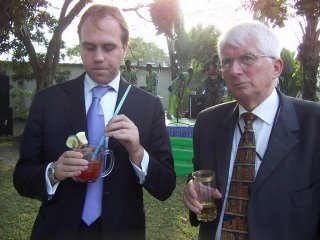 of the Netherlands Mission in Nigeria, stands here with Chief Joop Berkhout OON, Executive Chairman of Spectrum Books, at the Prince Claus Award Night. See more pictures
 of the Netherlands Mission in Nigeria, stands here with Chief Joop Berkhout OON, Executive Chairman of Spectrum Books, at the Prince Claus Award Night. See more pictures
Subscribe to:
Posts (Atom)


 Posts

